Couldn't load pickup availability
Edited by Erika Balsom, Beatrice Gibson, María Palacios Cruz and Ben Rivers
The Visible Press, June 2026
The Machine That Kills Bad People is an engaging and expansive collection of thirty-nine essays commissioned by the bi-monthly screening series at the Institute of Contemporary Arts, London, programmed by Erika Balsom, Beatrice Gibson, María Palacios Cruz and Ben Rivers from 2018 to 2026.
The Machine That Kills Bad People is, of course, the cinema itself – a medium that is so often and so visibly in service of a crushing status quo but which, in the right hands, is a fatal instrument of beauty, contestation, wonder, politics, poetry, new visions, testimonies, histories, dreams. It is also a film club devoted to showing work – ‘mainstream’ and experimental, known and unknown, historical and contemporary – that takes up this task.
The film club’s otherwise promiscuous programming was governed by a single rule that has remained undisclosed until now: only female filmmakers would be shown. As a result, this book offers an idiosyncratic journey through more than a century of women’s cinema, imagining new historical narratives and compelling its readers to question the status quo.
Steven Cairns – Foreword
Editor’s Notes
Elena Gorfinkel – Wanda, Loden, Lodestone
May Adadol Ingawanij – Follow the Sparrows: Anocha Suwichakornpong’s Mundane History
Leo Goldsmith – Flightpaths: Mati Diop’s Big in Vietnam
Laura Staab – Writing in Snow
Genevieve Yue – Movie Crush: Chick Strand’s Cartoon Le Mousse
Lucy Reynolds – “Being useful is a form of willing slavery …”
Ara Osterweil – Martina’s Playhouse and the Queer Space of Girlhood
Erika Balsom – Atlases of America: Babette Mangolte’s The Sky on Location and Deborah Stratman’s O’er the Land
Sara Saljoughi – You, Name a Few Beautiful Things: Forough Farrokhzad’s The House is Black
Daniella Shreir – Negotiating Intimacy on the Los Angeles Bus Network: Alexandra Cuesta’s Piensa en mí
Kit Duckworth – A Room of Their Own: Claudia Weill’s Girlfriends
Tendai Mutambu – A Stir in the Crucible: Alanis Obomsawin’s Incident at Restigouche
Andréa Picard – Everyday Epiphanies: Alice Rohrwacher’s Corpo celeste
Xiaolu Guo – Nudity is the Absence of the Hidden: On Trinh T. Minh-ha’s Reassemblage
Eileen Myles – Women Screaming
George Clark – Casual Encounters: The Untroubled Mind and Nervous Translation
Janique Vigier – Looking Back
Teresa Castro – Streams of Forgetfulness: On Manuela Serra’s The Movement of Things
Alice Blackhurst – Open Locks, Whoever Knocks! On Nina Menkes’s The Bloody Child
Juliet Jacques – Inventing the Future: On My Twentieth Century by Ildikó Enyedi
Corina Copp – Sparkle of The Outside
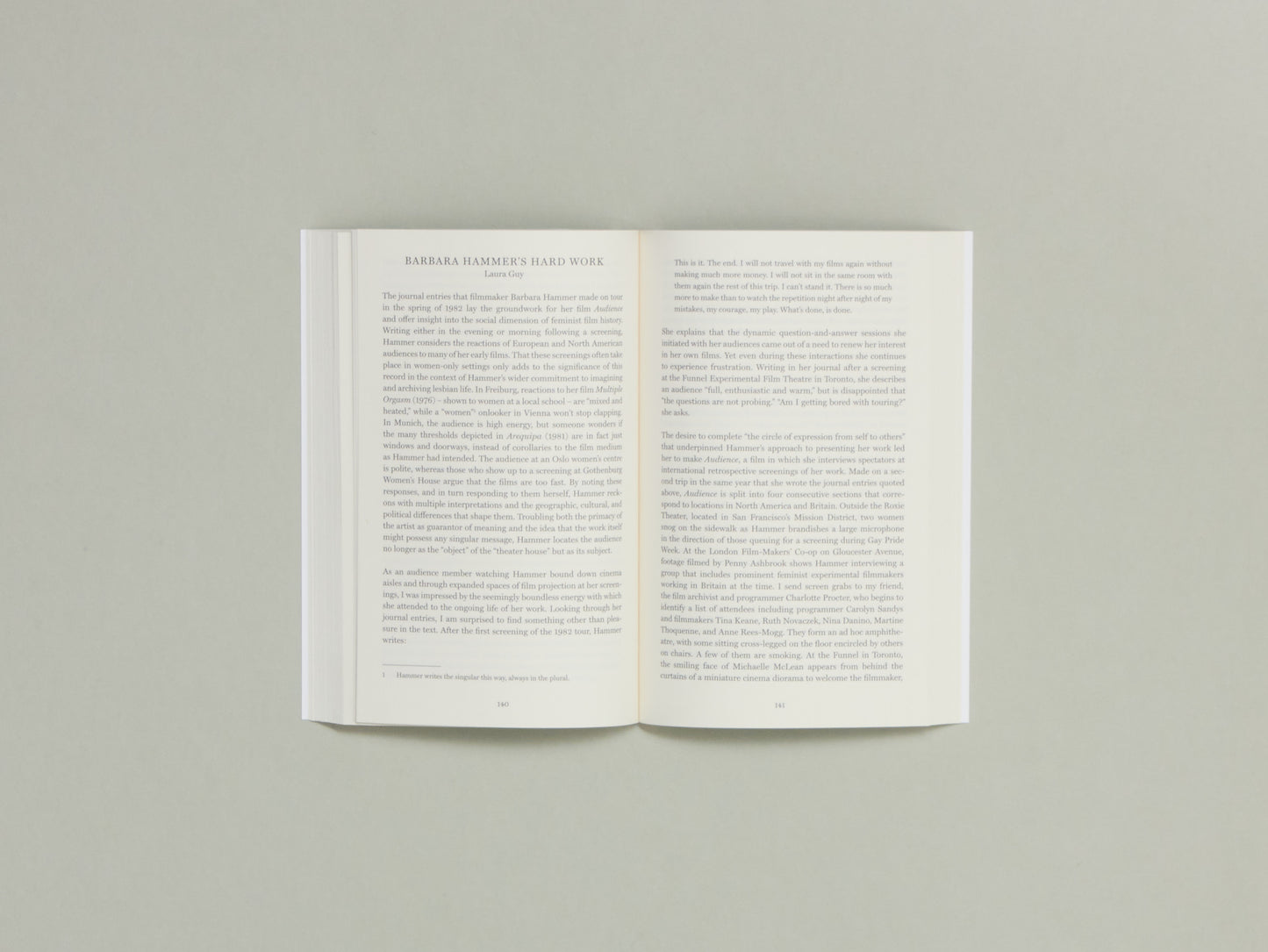
Laura Guy – Barbara Hammer’s Hard Work
Rebecca Jane Arthur – The Need for Roots: On Ruth Beckermann’s Paper Bridge
Amina Cain – All Desire Wants Eternity
Ricardo Matos Cabo – Ode to Mount Hayachine
Beatrice Loayza – I Like to Watch: The Helicopter Dreams of Kathryn Bigelow and Deborah Stratman
Sophie Robinson – This Black Hole’s Dark Heart
Laura Mulvey – Some Thoughts on Ida Lupino’s Outrage
Huda Awan – Violent Boredom
Chloe Aridjis – Cat – Reverie – Shadows – Reflections – Puppets – Agency –Handbag – Pendulum – Silence
CAConrad – Films for Light
Siavash Minoukadeh – Going Off Leash
Vanessa Onwuemezi – Is it Better to Be than to Obey?
Hannah Bonner – At Arm’s Length
Sophia Satchell-Baeza – On Verticality in Falling Lessons
Devika Girish – Dream Machine
Caitlin Quinlan – “Absently enchantedly Destined to splice it together”
Chris McCormack – Digressions on Hell
Erika Balsom, Beatrice Gibson, María Palacios Cruz, Ben Rivers – Blind Spots, or, the